Yes, this PowerPoint rendition is ugly as sin, but I wanted to quickly throw this out for feedback before getting mired in design. Disclaimer: I am NO artist!
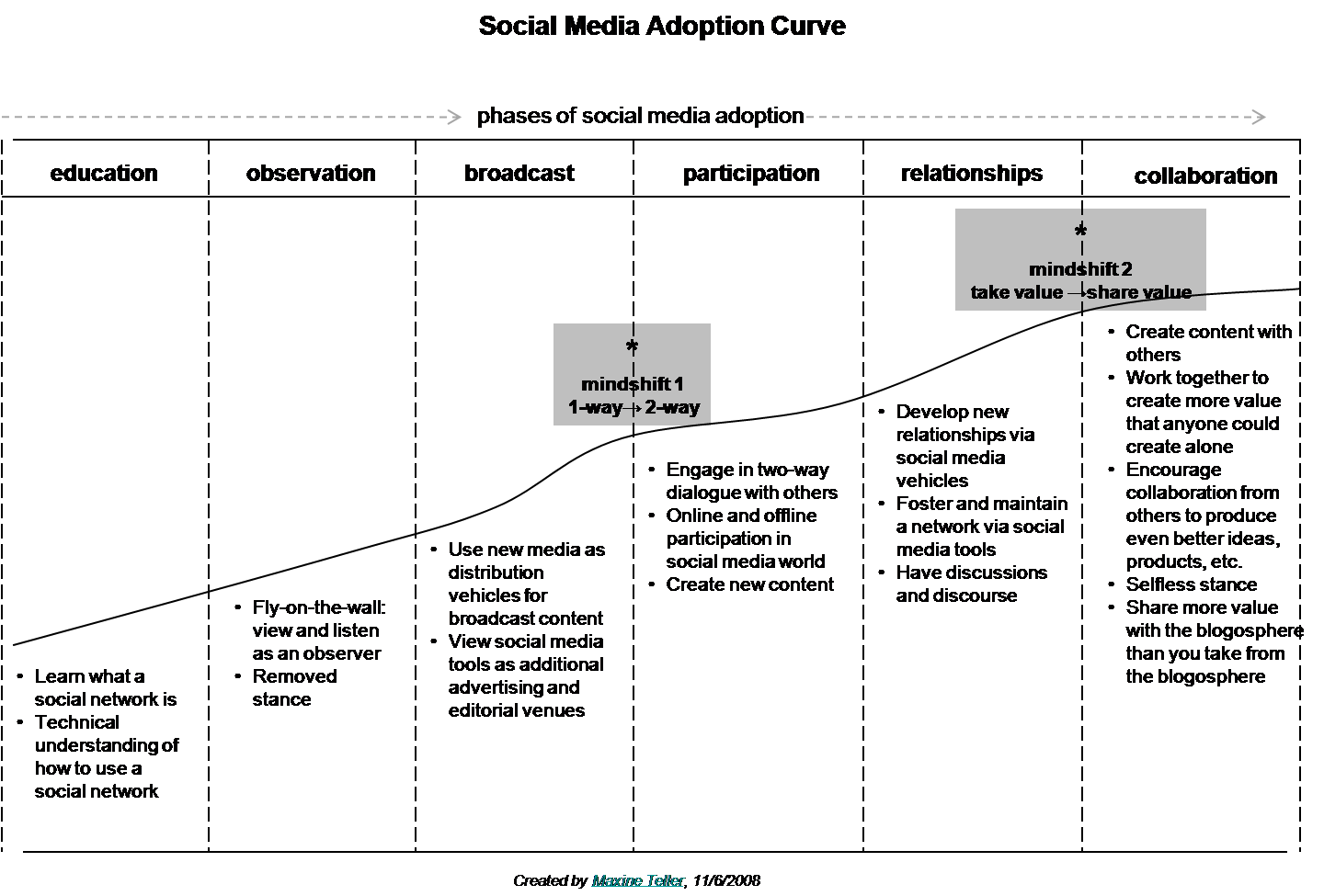
I came up with this continuum as I was thinking about the various phases that both individuals and organizations go through when breaking into and then evolving in the world of social media.
The diagram is pretty self-explanatory, but I want to point out the two “mindshifts” that I’ve identified along the curve. The first mindshift occurs between the “broadcast” and the “participation” phases, when the individual or organization has the “ah ha” moment of realizing that social media is not another broadcast tool, but rather, a way to engage with others. The second mindshift occurs between the “relationships” and the “collaboration” phases, when the individual or organization realizes that focusing on increasing the value for others–the collective–is more beneficial (to the individual/organization AND others) than focusing on increasing the the value for itself.
Medication errors can happen anywhere, but you can protect yourself. There are many of legal online drugstores that will offer legitimate discounts. Certainly it isn’t all. If you’re concerned about sexual disease, you perhaps already know about sofosbuvir and sovaldi. What professionals talk about sofosbuvir hep c? (Read more sovaldi). The signs of sexual problems in men include inability to maintain an erection sufficient for sexual functioning. Happily many problems with sexual soundness can be treated. Before purchasing Kamagra or any other generic, discribe your physician your health state. Health care producer may order specific tests to rule out any other problems that may be contributing to the malfunction. Get vocational help if you have any of these signs of a side effect to the remedy. If the preparation you are taking is not approved, your doctor can prescribe another formula medicine.

I wouldn’t have thought of it this way intially, but I really like the way you’ve set this up. Also, I think it’s important for people/companies to get through that third stage as quickly as possible, because being only a broadcaster without any engagement is the quickest way to lose credibility on any social network.
This is great. I might only add, that this process is often times cyclical depending on the type of social media tool. To be successful, I think it takes a continues application of learning, observing and engaging.
Also, I would defer to the Diffusion of Innovation Theory and the famous bell curve. Is there anything that comes after collaboration? Do people phase out? I’ve heard of people joining Twitter, not getting it, and stopping all together. Also, beside being a social media adoption chart…what’s the purpose of the adoption? …and does that purpose influence one’s adoption level/process? That could be a could tie in as well.
Hope that is helpful. Great thinking, and I’m curious to see what the final product looks like!
Can we call the Social Media Adoption Curve “the SMACk”?
Leave it to @cheeky_geeky (twitter ID for Mark) to come up with the snappy acronym! 🙂
I really like this model, Maxine. Though I think this primarily reflects the adoption of web 2.0 tools at the enterprise level, not the individual level. To use a hyperbole, if you have an organization entirely of “contributors” but no “consumers,” then you have a lot of people talking, but no one listening. Chalk it up to personality type or something else, there will always be a sizable amount of “quiet” individuals, though they may be active (in their own way) in the collaborative spaces.
Then again, I could just be rationalizing my own introversion and my lack of greater engagement in these tools! (or it could be the three small children who demand much of my after-work time!). 🙂
I really like the idea and the layout approach. I’m especially intrigued by the mindset shifts. I think this is especially critical for the individual at the participation point, and just as critical for the organization when they start changing their communication channels as a result (your collaboration mindset shift).
I do wonder though whether the same curve for individuals also applies to organizations. The other question I would have is whether this graph is really talking more about social networking tools vice all social media tools.
Adam, I have to agree with you, Maxine interpretation does seem to represent the enterprise adoption curve. The curve in my eyes for individuals varies on the person.
So:
Person 1: Never hears about it
Person 2: Hears about it, does nothing
Person 3: Hears about it, observes and looks into it
Person 4: Hears about it and initially/casually participates
Person 5: Hears about it and dives right in
Person 6: Hears about it, dives in and evangelizes
Mark, love the SMACroynm. It’s a go!
Adam and Andrea,
Thanks so much for your comments and suggestions. I’m not sure there is a difference between enterprise and individual adoption because social media tools level the playing field and give individuals the same capabilities and potential for impact as were previously only available to organizations, i.e. a blogger can “speak as loudly” as a media company.
Adam, good point about one’s propensity towards introversion or extroversion. Is introversion a liability in social media adoption? Does this indicate that introverts are the next underclass?
Regarding your point about kids and other responsibilities limiting social media involvement, I’ve thought a lot recently about the tremendous time commitment required for participation and collaboration in social media. Those with more time to commit to social media are likely to move along the curve faster than those with limited time. Interesting implications here re: a social media super-user. Is the social media super-user a higher-evolved collaborator or does he/she need to “get a life”?
I agree that listening, monitoring the social media space is a crucial component of participation and collaboration. I go back and forth as to whether it’s easier to listen or to speak in social media.
Andrea, I think that the 6 people you’ve outlined just fall at different points on the SMAC. The curve doesn’t mean that everyone will move through the whole process. People will settle in and fall off at all points along the way.
Laya, thanks for joining the conversation here! Yes, I agree that spending too long in “broacast” mode is a way to kill credibility! The challenge is that you can’t see this when you’re in broadcast mode… you think you’re participating… until that mindshift kicks in and you have that “ah ha” moment of realization that you’ve been doing it all wrong.
socialbutterfly4change, thank you for your ideas and good–but really tough!–questions. I agree that there is most certainly something beyond “collaboration.”
I am very excited to study the Diffusion of Innovation Theory. I have actually been working on a piece about social media and innovation. I tend to believe that that’s what’s beyond collaboration…
As for the cyclical nature of observing, learning, engaging–perhaps these are the stages that an individual/organization goes through at EACH phase along the curve..? Will think more about all of this.
Thank you for stretching me on this….;)
Noel, thank you, as well, for your comments and ideas. Question for you: what’s your differentiation between social networking tools and social media tools?
Hi Maxine, I see social networking as one variant of a larger category. For instance, Wikis would be considered social software (I probably prefer social software over social media as a term) or social media, but I don’t know that you would call it social networking. You might not be doing the relationships part above, for instance, but certainly could use Wikis for advertising and collaborating. Social bookmarking probably also doesn’t do all the items listed above, or social prediction markets, etc. But it seems to me that social networking tools could easily fill all the areas you list above.
I guess my overall thought is that the buckets have become too large and muddy (especially web 2.0), and that perhaps since the “newness” factor has worn off, we should consider adding a bit more differentiation to the categories. In line with this, if we are looking at an adoption curve, it might make sense to look at social networking as its own category, as Wikis, for instance, might have a somewhat different look.
Noel, very good points. To address your second point first: per another comment about this post, I indviduals go through this process/curve with each tool that they adopt. So, I could be collaborating on Twitter, but just observing on blogs. As for your first insight that social networking has many sub components.. perhaps social software is a better term. The only issue that I have with that is that the tools and technologies are just enablers of the culture-changing social interactions. Perhaps “Collaborative Adoption Curve” would be a better name? This would encompass the personal interactions as well as the tools that enable them. Let me know what you think…
I want to make this as clear as possible, but would hate to lose the acronym of SMAC… 😉
Maxine,
The curve is interesting and I agree with the comments. The real value here (that I see at least) is the context you’ve created for the two mindshifts. That really nails it. I also think it goes beyond (way beyond) social media. The more companies learn that they need to talk with (instead of at) and create and share value (rather than hoarding it), the sooner the entire pie increases.
Thanks for the insight.
Doug, thanks so much for commenting. Yes, I agree with you — it goes way beyond social media. Social media tools are catalyzing a cultural shift that is comprised of a series of these “mindshifts.” You’re right to bring up the point that the offline world can learn a lot from the online world. I always think about this when I’m at a diner that serves coffee cream in one of those clumsy metal creamers that spills when you try to pour it. Some basic usability testing would have solved that problem prior to production. I’m constantly amazed that usability testing hasn’t become the norm for physical goods…
As for the cyclical nature of observing, learning, engaging–perhaps these are the stages that an individual/organization goes through at EACH phase along the curve..? Will think more about all of this.
Canli, yes, indeed. The more I think about this, the more I realize that individuals are the lowest common denominator for this curve — not enterprises. Enterprises are comprised of individuals who will be a different points along the curve.
I met with a team of 15 social media believers at a small government agency last week. They had come together not by senior management mandate, but by bottom-up interest. They believe that social media tools are critical to the success of their programs and have done some great low-cost dabbling to show this to non-believers and, ulitmately, prove their case. I drew the curve for them and explained that their biggest challenge is that their team is past the first mindshift–they are building relationships and participating. Their senior management, however, may not even be in the observing phase yet. It’s very tough for those lower in an organization to bring along their management when management controls resources. Internal believers/evangelists often have to use their own time to build a case that will convert or at least spark interst in senior management. Building internal alignment will slow an organization’s adoption of social media, but it’s critical for enabling the mindshifts that are essential for successful adoption.
Maxine – I like where you are headed but I think a couple of key points could be added from the Enterprise perspective.
1. Whoever is designated a participant from the Enterprise needs to immerse themselves, personally in social media networks, blogs and/or micro-blogging services like Twitter. This immersion is part of the education and observation process. We actually did this at my company to get the ball rolling.
2. The mindshift from 1-way to 2-way also needs to consider the policy implications. How should, and most important, how should not, an employee of the enterprise engage in the social media ecosystem on behalf of the firm. Basically, what is your enterprise public policy? This sets the boundaries for employees and helps keep the enterprise out of trouble when engaging in social media. As you well know there are many groups and individuals that are sensitive to enterprises engaging in social media. I have even seen a study that described companies on Facebook as stalkers.
3. Also, at some point on your Adoption Curve, enterprises need to establish, encourage and reward the people resources necessary to make a social media effort successful. The cost of social media for large brands is high, not dollars, but personnel time commitment. This is a real problem because typically enterprises assign a person as the Social Media Guru who then essentially becomes the face of the brand in the social media ecosystem. This is dangerous, especially if that person leaves the enterprise to join a competitor or another firm.
So, to simplify, I think if you added immersion, policy and resource components to the adoption curve, you will be getting closer to what you are trying to achieve.
Enjoyed the post and graphic. Looking forward to seeing the evolution of the Social Media Adoption Curve.
Bert, very insightful points I agree with you. The Catch-22 is that it’s often not senior leaders in an organization who first drink the social media Kool-Aid. So, securing approval and resources to enable immersion is difficult. As I said in my response to Canli (below), bringing senior management along and getting them to see the importance and value of social media by understanding the costs of NOT participating is essential. If you can get senior management to really make the mindshift, then policy and reward structures can be created. You’ve inspired me to noodle a post about how to create internal alignment necessary to create and execute a cohesive social media strategy! Thanks very much for commenting.
Heay Maxine,
this is awesome and I like your idea of formulating the adoption process, though I also think it is partly a circular process, starting over for every new tool (especially the larger the company in focus). I’m researching at Daimler AG in Germany on the issue, managing the Daimler-Blog (http://blog.daimler.de). Maybe you’re interested to set up a case study together, employing your approach to a real life scenario?
Cheers, Nils
Nils, thank you for commenting. I agree, this is a process that individuals go through over and over for each tool that they try out: blogging, Facebook, Twitter, etc.
I’d love to hear about the work you’re doing at Daimler and would certainly like to disuss the potential of doing a case study together. Let’s take this offline. E-mail me at: maxine@mixtmediastrategies.com.
I realize I’m late to the party, but…
You know, there’s some parallel to how an individual begins to socialize with a workgroup, even without social media.
A lot of people follow the path of the curve: get into the new job or group, look around, see what’s happening. (I think participation and broadcast are probably reversed, because you gotta start doing stuff with your peers/coworkers before you start spreading whatever it is wider.
In the new organization, your networks flow out more slowly than online, and tend to be geographically bound (unless a big part of your job is working with the folks in Parsippany or Perth).
I wonder whether the relationship / collaboration columns, in this individual/group sense, connect with going beyond the strict definition of your typical job. I work in the training/learning/performance-improvement field. The more traditionally defined end: solve at-hand training problems. The more networked / outward-looking end: improve performance, whether through training or other means. That requires a wider, more varied network.
Just found it,
great diagram!
Hello webmaster
I would like to share with you a link to your site
write me here preonrelt@mail.ru
Thanks for sharing this adoption model.
It’s impossible to integrate all aspects that are related to this subject, but I think you’ve done a great job in creating an overall and clear model!
what is a “Stance” in this context? Removed Stance, Selfless Stance; i’m not sure what that means.
Hi Maxine,
Commendable efforts. This has helped me shape some of my ideas around S.M. adoption, interestingly Bloom’s Taxonomy ( http://en.wikipedia.org/wiki/Bloom%27s_Taxonomy#Cognitive ) talks about Analyze, Evaluate, Create | Apply, Understand, Remember. Firstly let me point out S.M.Adoption is a “Process”.
During : Education, Observation, Broadcast phase >> we see that S.M. user is first analyzing the technology ( i.e. How Stuff Works ?? ) , after playing with it for a while in the process the user is learning ( i.e. What Does What !! ). It is only when the realization ( = 1way > 2way “Mind.Shift” ) dawns, the S.M.user understands ( usually when user “participates” ) that its not about themselves but “others”. In order to see what the person understood they start applying in dialogues or cohort organization ( around theme ), this is when the person starts building relationships.
VOILA : collaboration >> “engagement” >> GOOD FOR ALL !!
[ aryabhatta.INFORMATICIAN ]
DHSi, Johns Hopkins University
http://www.informatizing.us
Blog Council: thanks so much for your post that points to mine. I appreciate you broadening the reach of the conversation about this.